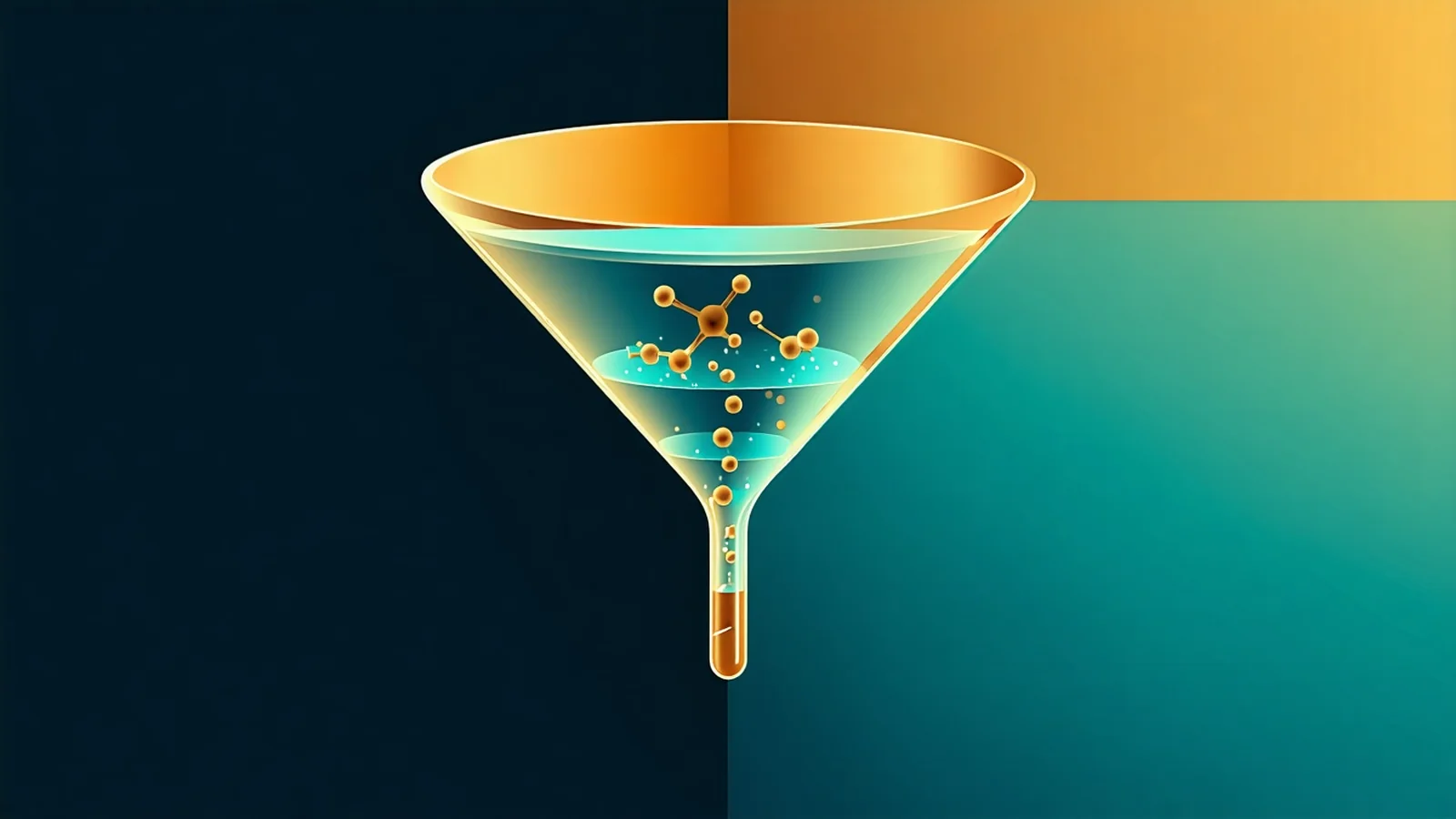
The assay fired. Your biochemical screen returned 47 apparent hits from a 50,000-compound library, a hit rate that looks promising until you discover that 30 of those compounds belong to a class of chemical troublemakers that have been contaminating early drug discovery for decades. We have seen this scenario play out repeatedly in early-stage screening projects. PAINS, Pan-Assay Interference Compounds, are not just an inconvenience. They are a systematic source of false positives that, if left unfiltered, consume wet-lab resources, delay timelines, and occasionally send programs chasing ghosts all the way to costly synthesis decisions.
Where PAINS Come From: The Baell-Holloway Analysis
The foundational PAINS paper, Jonathan Baell and Georgina Holloway's 2010 publication in the Journal of Medicinal Chemistry, analyzed 500 known assay interference compounds from publicly available HTS data and extracted 480 substructural alerts grouped into three filter sets: PAINS-A, PAINS-B, and PAINS-C. Not equally weighted. PAINS-A covers 182 alerts and represents the most promiscuous offenders; compounds flagged here are almost always problematic across multiple target classes. PAINS-B and PAINS-C contain fewer, less-frequently triggered alerts but remain important for complete coverage.
What Baell and Holloway identified is that these compounds do not interact with their reported targets through specific, reversible binding. Instead, they interfere with the assay itself. Colloidal aggregators disrupt enzyme kinetics nonspecifically. Reactive species covalently modify multiple proteins indiscriminately. Fluorescent compounds produce artifactual readouts in fluorescence-based assays. The result: high apparent activity across structurally unrelated targets, which is exactly what you should not see from a true lead compound.
In their dataset, compounds flagged by PAINS-A had a median promiscuity score nearly 5-fold higher than non-flagged compounds. That single data point should be enough to change how any cheminformatics team approaches library filtering.
The Structural Alerts You Need to Know
Understanding why certain structural motifs end up in PAINS filter sets helps calibrate when to trust and when to override a flag. The major culprits:
| Alert Class | Representative Motifs | Primary Interference Mechanism |
|---|---|---|
| Michael acceptors | Enones, vinyl sulfones, acrylamides | Covalent Cys/Lys alkylation; non-specific across protein targets |
| Quinones / catechols | Benzoquinones, hydroquinones, catechol esters | Redox cycling, ROS generation, metal cofactor chelation |
| Rhodanines | 2-thioxo-4-thiazolidinone core | Colloidal aggregation, covalent adduct formation |
| Thiol-reactive species | Isothiazolones, thiazolidinediones | Broad cysteine alkylation in thiol-sensitive assay formats |
| Fluorescent scaffolds | Naphthalimides, certain rhodamine derivatives | Artifactual signal in FRET and fluorescence polarization assays |
Each alert has a mechanistic rationale. It is not arbitrary pattern matching. This matters when you are deciding whether to override a flag, because the mechanistic framing tells you which assay formats are most vulnerable and which counter-assay designs will give you the clearest answer.
Rhodanines deserve a special mention. We have seen programs spend months optimizing rhodanine-core compounds before physicochemical profiling revealed colloidal aggregation was responsible for all observed activity. The five-membered ring containing both nitrogen and sulfur appears in hundreds of published HTS hits. It keeps showing up in medicinal chemistry literature as a reported lead scaffold. Do not be one of the programs that finds out the hard way.
Implementation: RDKit and ChEMBL
The practical implementation of PAINS filtering in a modern cheminformatics workflow is well-supported. RDKit includes the Baell-Holloway alerts as a built-in filter set accessible via rdkit.Chem.FilterCatalog. Running a compound through all three PAINS sets takes roughly 2 milliseconds per molecule at single-thread throughput. Negligible cost relative to any downstream processing.
A minimal implementation looks like this:
from rdkit.Chem import MolFromSmiles
from rdkit.Chem.FilterCatalog import FilterCatalog, FilterCatalogParams

params = FilterCatalogParams()
params.AddCatalog(FilterCatalogParams.FilterCatalogs.PAINS_A)
params.AddCatalog(FilterCatalogParams.FilterCatalogs.PAINS_B)
params.AddCatalog(FilterCatalogParams.FilterCatalogs.PAINS_C)
catalog = FilterCatalog(params)

mol = MolFromSmiles("O=C1C=CC(=O)c2ccccc21")  # anthraquinone example
matches = catalog.GetMatches(mol)
for m in matches:
    print(m.GetDescription())  # returns e.g. "PAINS_quinone_A(2)"
ChEMBL incorporates PAINS flags in its compound annotation pipeline. Any medicinal chemistry team pulling hits from ChEMBL for target profiling can query structural alert annotations alongside physicochemical properties. ChEMBL exposes PAINS annotations in the compound report card for most molecules, making cross-referencing straightforward during triage.
In our experience, applying PAINS filtering immediately after primary screen deduplication and before dose-response cherry-picking removes between 8% and 22% of apparent hits depending on library composition. The variance is real: a diverse commercial library tends toward the lower end; a historical in-house collection accumulated over many years can approach 30% PAINS contamination if screening criteria were never previously applied.
When PAINS Flags Are False Alarms
Important caveat. PAINS filters produce false positives. Not every flagged compound is genuinely problematic in every assay context.
Catechols in phosphatase assays? Problematic. Catechols in SPR-based binding assays where the readout is not enzyme activity? Less so. Acrylamide warheads in an intentional covalent kinase program targeting a specific surface cysteine? That is literally the point. The alert fires on the structural feature, not on the assay context. This distinction matters for programs where covalent mechanisms are deliberate, not accidental.
Baell himself has noted that the filter sets should be treated as flags, not vetoes. Experienced medicinal chemists recognize this. The failure mode we see more often is the opposite: organizations with no PAINS filtering pipeline at all, or teams that run the filter and then ignore outputs because someone senior on the team is attached to a rhodanine-core compound that showed activity in four assays. Four assays. All optical readouts. All producing signal for the same mechanical reason. Hard to let go of. Let it go.
The right practice: PAINS flags trigger orthogonal assay confirmation. Does the compound show activity in a non-optical format? Does thermal shift assay or SPR confirm direct binding? Can you rule out aggregation with detergent counter-screening at 0.01% Tween-20? These confirmatory steps add days, not months. Worth it before any synthesis investment.
Combining PAINS With Toxicophore Screens
PAINS filtering and toxicophore screening address different liabilities and should run in parallel, not in sequence. PAINS primarily targets assay interference at the hit identification stage. Toxicophore filters, such as Brenk alerts, REOS, Pfizer's 3/75 rule, and Lilly's medchem filter set, target developability liabilities that manifest later in the pipeline: metabolic instability, genotoxicity signals, organ toxicity flags.
A combined filter stack we apply in virtual screening triage typically includes:
- PAINS-A/B/C via RDKit FilterCatalog (assay interference)
- Brenk structural alerts (reactive functional groups, metabolically labile bonds)
- Custom toxicophore exclusions (anilines, nitroaromatics, thioureas in specific ring contexts)
- ADMET property pre-filters (MW below 500, cLogP below 5, HBD at most 5)
Running all four layers on a 200,000-compound virtual library typically reduces the set to 60,000 to 90,000 candidates before docking or shape-based scoring. That 55-70% reduction comes primarily from property filters; structural alerts account for 10-15% of eliminations. But that 10-15% matters more than the percentage suggests, because reactive compounds score favorably in many docking protocols. They look like they bind because they are calculated to form short contacts that are actually covalent traps, not genuine non-covalent interactions.
Practical note: in a 2022 retrospective analysis of 14 reported HTS campaigns, approximately 18% of published confirmed hits contained at least one PAINS alert, and fewer than half had been subjected to aggregation counter-screening. The wet-lab follow-up on those compounds represented, by the authors' estimate, over $2.4 million in avoidable costs across the campaigns reviewed.
Practical Workflow Integration
The operational question is not whether to apply PAINS filters but where in the funnel to apply them. Our data supports applying PAINS-A as a hard filter on any compound entering dose-response confirmation, with PAINS-B and PAINS-C as soft flags that require annotation and rationale before proceeding. This approach avoids both over-filtering valuable scaffolds and allowing known interference compounds to consume synthesis resources.
For teams building screening libraries prospectively, PAINS filtering should run at library design time, not retrospectively at hit triage. Purchasing 10,000 PAINS-contaminated compounds is a waste that compounds over every screen they enter. The cost difference between a PAINS-annotated library and a non-annotated one from commercial vendors is typically under 5% in added curation fees. Worth it. Every time.
The longer-term benefit is institutional. Teams that systematically track PAINS hit rates across library segments learn which vendors and which historical acquisition cohorts carry the most interference liability. That knowledge shapes future procurement decisions and improves overall library quality over years of operation. One CRO client we work with reduced their false-positive hit confirmation rate by 31% simply by implementing PAINS pre-filtering at the library procurement stage, before a single compound entered a biochemical screen.
Putting It Together
PAINS filtering is one of the few genuinely uncontroversial practices in early drug discovery. The mechanistic rationale is solid, the implementation is accessible in open-source tooling, and the downstream cost avoidance is documented across multiple published analyses. The remaining question is coverage: PAINS-A/B/C describe the interference landscape as it was characterized in 2010 using the HTS data available then. The assay landscape has shifted. Proximity assays, cell-based phenotypic screens, and direct biophysical methods have different vulnerability profiles than the enzyme inhibition assays that dominated the original dataset. Supplementing Baell-Holloway with ChEMBL-derived promiscuity data and target-specific orthogonal counter-screens remains current best practice.
Simple in principle. Consistently under-applied in practice. The teams that enforce this filtering early and rigorously spend their wet-lab budget on candidates worth optimizing.
Moleculepath Bio integrates PAINS filtering, toxicophore exclusion, and orthogonal counter-screen recommendations into every virtual screening engagement. Request a consultation to discuss your hit identification workflow.